Govern your memory
Make your knowledge a compounding asset.
Starling MX codifies and securely maintains everything your business knows, in an Org Library you own and permission.
Leading AI models work from it, and none trains on it. Your people decide what becomes memory. From $99/month.
Why now
Human-governed AI starts with owning what you know.
No matter how strong the policy, every AI tool keeps some of what it learns about your business. Starling is designed for Zero Data Retention (ZDR) AI systems: the model doesn’t need to hold your data, because it’s organized for query-based context assembly. Your people decide what goes in. The AI works from it and doesn’t train on it.
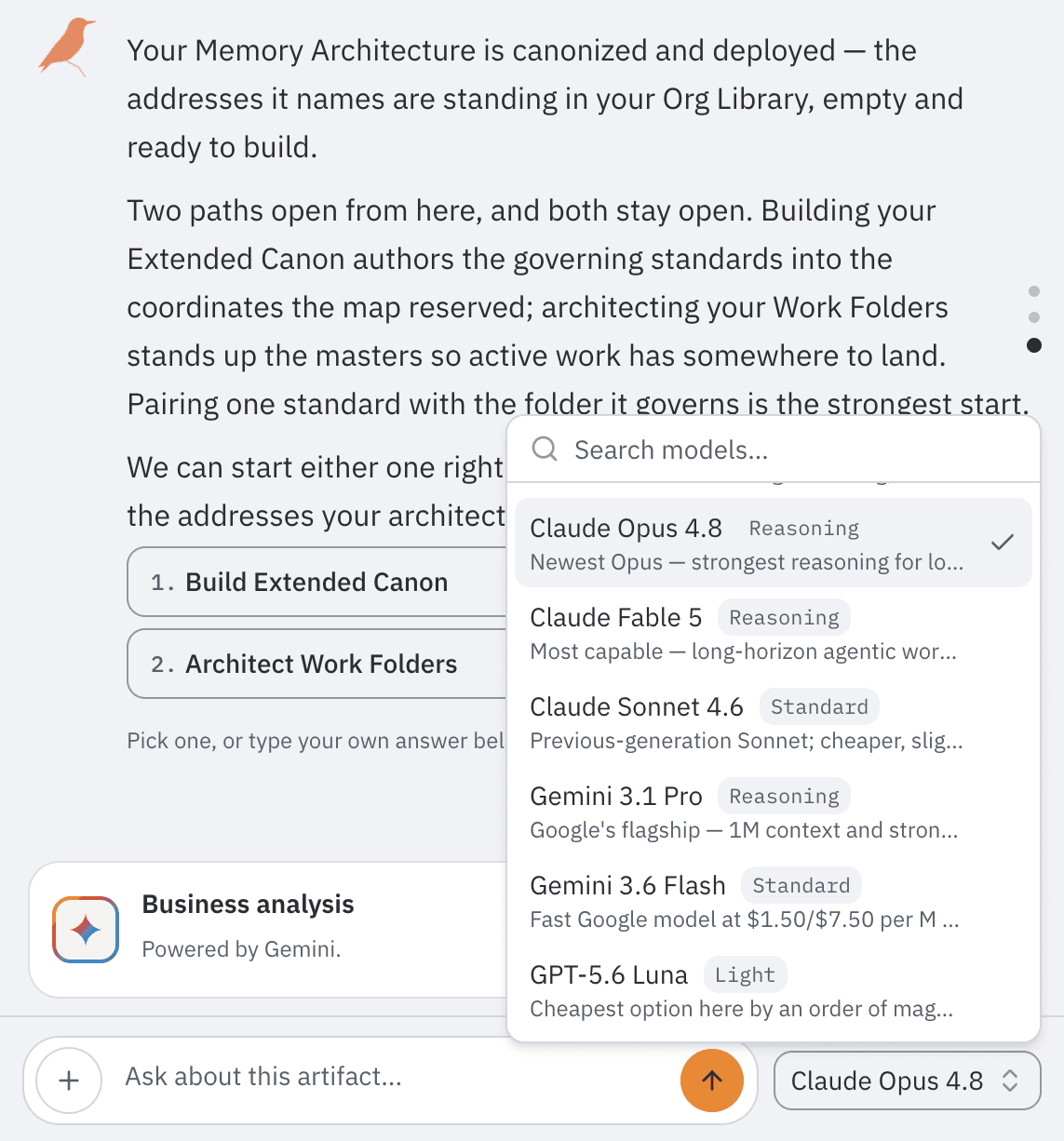
Switch models mid-project, or select the best one for each task. Claude, GPT and Gemini all work from the same Org Library, so nothing is lost when you change.
Our solution
A sovereign AI chief of staff, built on your knowledge.
Each model is handed only what the task needs; the library stays yours. Day to day, Starling:
- Works with everyone, from the front line to the board. The CEO briefs the board and a new hire drafts against the same governed memory.
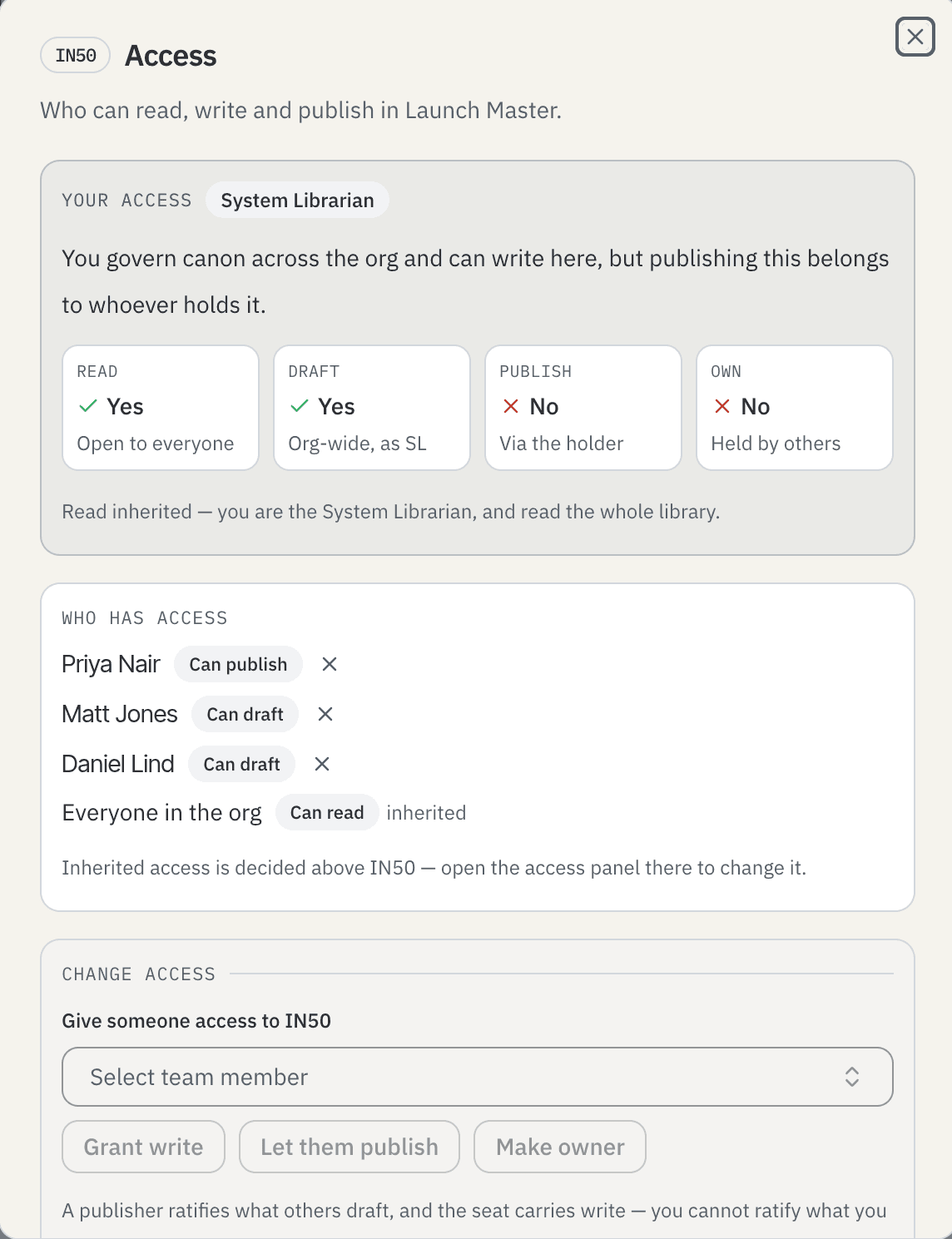
- Works within each person’s permissions. Read, draft, publish, own — granted per person and folder. Team members work only where they’re scoped.
- Speaks every language in your business: the thousands of API and application languages, and the different nomenclatures your departments work in.
- Does the actual work, in any format. A memo, deck, P&L, board briefing, handbook, website, and more — drafted to your standards.
- Sees the whole library so your AI doesn’t need to. Ask a question that spans documents and it answers by address — surfacing any conflict.
- Turns every deliverable into memory. Finished work is staged to commit back to the brain at its address, so the next task starts from more than the last.

Ask me anything, Priya
Define Your Memory
Create your Org Library — with every AI artifact organized so your knowledge is the asset.
An Org Library places everything your business knows at the top of your tech stack, in a repository you own and control.
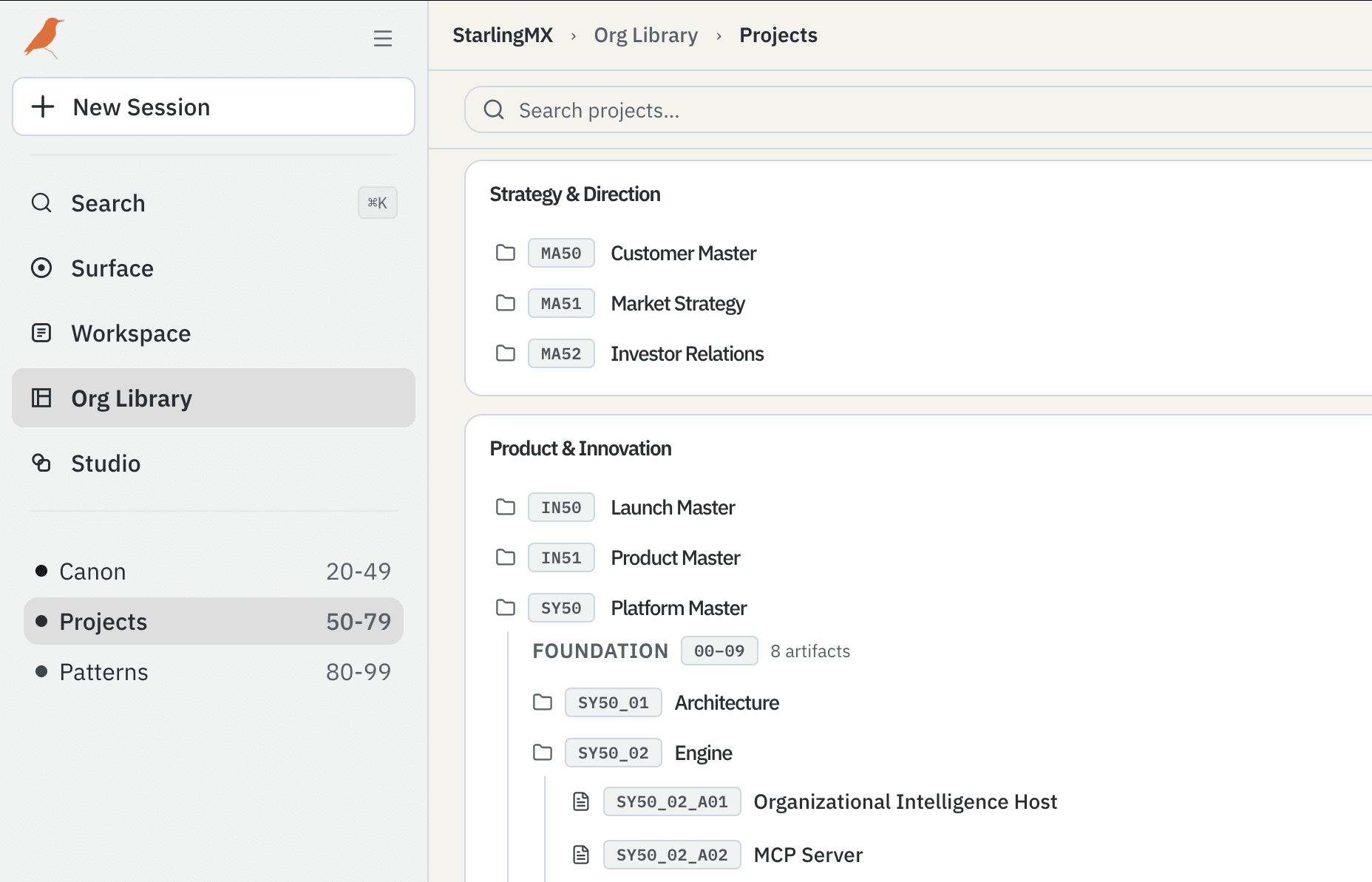
A universal memory system you refine with every commit.
Starling’s operating system codifies the Canon and Patterns that define your institutional knowledge, and grounds active Projects in essential context. Those three authored tiers live as lossless truth in your Org Library, managed by a System Librarian, the administrator who approves what becomes memory, who governs the first two and permissions the third. Starling’s Cognitive Design playbook helps orchestrate your agents; a human governs every commit.
Memory Tiers
- MA21 Business ModelPersistent Memory Node
- Canon
- MA50 Customer MasterActive Memory Folder
- Projects
- IN80 Org Brain as Head CodeLearning Memory Node
- Patterns
A human reads the names; a machine resolves the addresses.
What an Org Brain provides
Together, Starling OS and your Org Library provide the operating logic and organizational truth that constitute an Org Brain.
- It’s governed person by person. Every node in the Library carries permissions — the OS provides relevant memory to those who can read, write, and publish it.
- The Library is yours. Canon, Projects, and Patterns sit at permanent addresses in a repository you own — not inside a model.
- Work is memory. Starling OS treats active work as memory — addressed, governed, and watched for drift against your canon.
- The Brain never fills. Instead of piling in context until a window dumbs down, Starling assembles fresh by query, so the Org Brain can keep growing.
How it works
The Domain Language Model (DLM)
An architecture that doesn’t compete with AI systems, but contains and governs them.
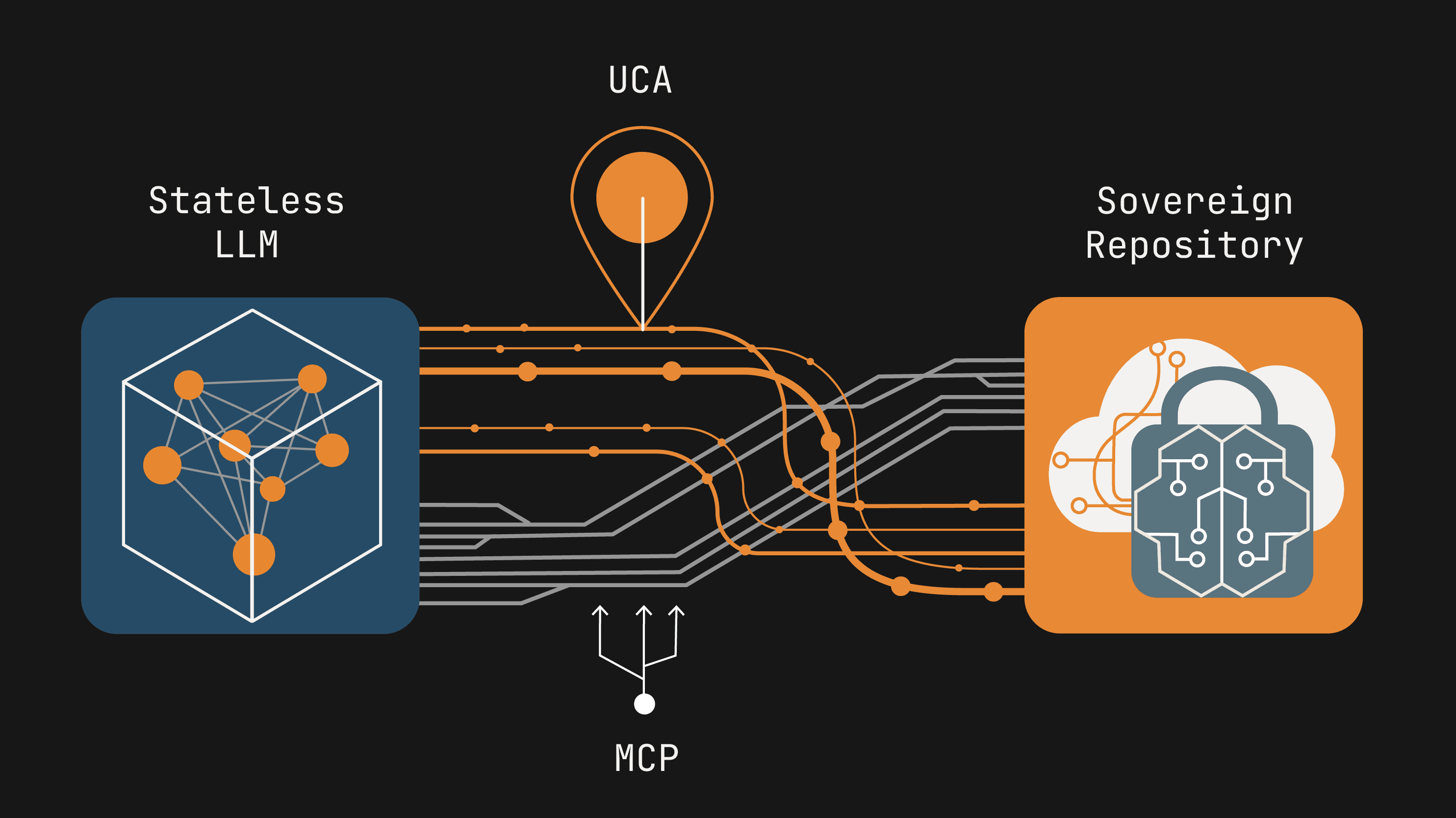
A Domain Language Model (DLM) is defined as stateless, interchangeable AI systems reading and writing to a sovereign repository. In plain terms, your organization’s knowledge and work live in a repository you own and control, structured so session-based AI runs efficiently: context in, work out, nothing kept in the model, tokens managed. What the provider keeps of each call is bounded by its published terms.
Starling MX is an assembly DLM: context is assembled before the model is called, so what the model reads is sized to the question, not to your library. It uses the open Model Context Protocol (MCP) and our free Universal Cognitive Architecture (UCA) classification standard to assemble context by address, not search. A sovereign repository holds both operating system and organizational memory.
Cross-Intelligence
Sovereignty isn’t a trade-off. It’s an upgrade.
The labs keep moving the ground. The enterprise systems built for the last generation of models are already behind the newest releases.
They’re racing to build “super-intelligence” into bigger and bigger models. The real gain is Cross-Intelligence — the best machine capacity working from your secure human intelligence. Build on memory you own, and the next model upgrade is a swap, not a rebuild.
Stored AI memory hardens and drifts — a Monday pivot can take weeks to land. Starling reasons over governed canon that stays current, so every model works from what’s actually true.
The result? Better intelligence, real ownership, and peace of mind. The model never holds your business — only the slice a task needs, on a need-to-know basis, assembled before it’s ever called.
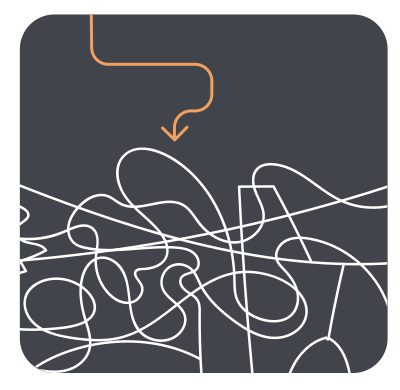
AI Memory
drifts · probabilistic
Memory created by AI lives in vector databases. The more data, the wider the RAG search. A pivot takes weeks to land.
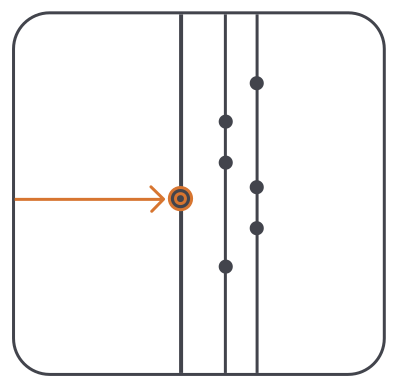
Starling
current · deterministic
Starling’s machine-side manifest assembles context from your human-side repository, and flags drift for a person to review.
The economics
Not another AI system. A business accelerator, in daily conversation.
$99/mo for the Owner’s Seat, with $99 of AI usage included. Cost-plus token usage beyond it.
01
Free to start. The UCA standard is free and complete. Load it into any AI, write down your First Fifteen, and turn the AI’s memory off.
02
The build, once. Your first month on Starling MX stands up your Org Library — your canon, standards, and memory architecture. The kind of accelerator that used to run thousands, executed in onboarding.
03
Stay for Starling OS. After the build, a single Owner governs your memory system, which runs on Claude, GPT, and Gemini. On Smart Enterprise, it connects to any MCP-accessible AI you already run.
04
Bring your team with no per-seat tax. You only pay for one seat, then cost-plus for the work the AI does — metered to the token, not charged per head — on a variety of models, not one lab’s.
Most tools sell you seats. Starling sells you just one.
See pricingTwo ways in
Starling works at any scale.
Give your business the gift of context.

Smart Office
Our self-serve platform for small business.
Create your repository; invite your team.
Smart Enterprise
We design and staff your governed intelligence system.
For larger organizations, architected with and owned by you.
Stay in context
Get the Intelligence Brief.
Subscribe to On Cognitive Design, from Chris Kincade, CEO, Starling Memory Works.