How it works
From scattered files to a governed brain.
Five moves take your organization from hundreds of incompatible languages to one governed memory any AI can read.
At every move, a person owns and governs the memory.
The model is the utility that reads it.
Universal Cognitive Architecture
Give every piece of knowledge a permanent address.
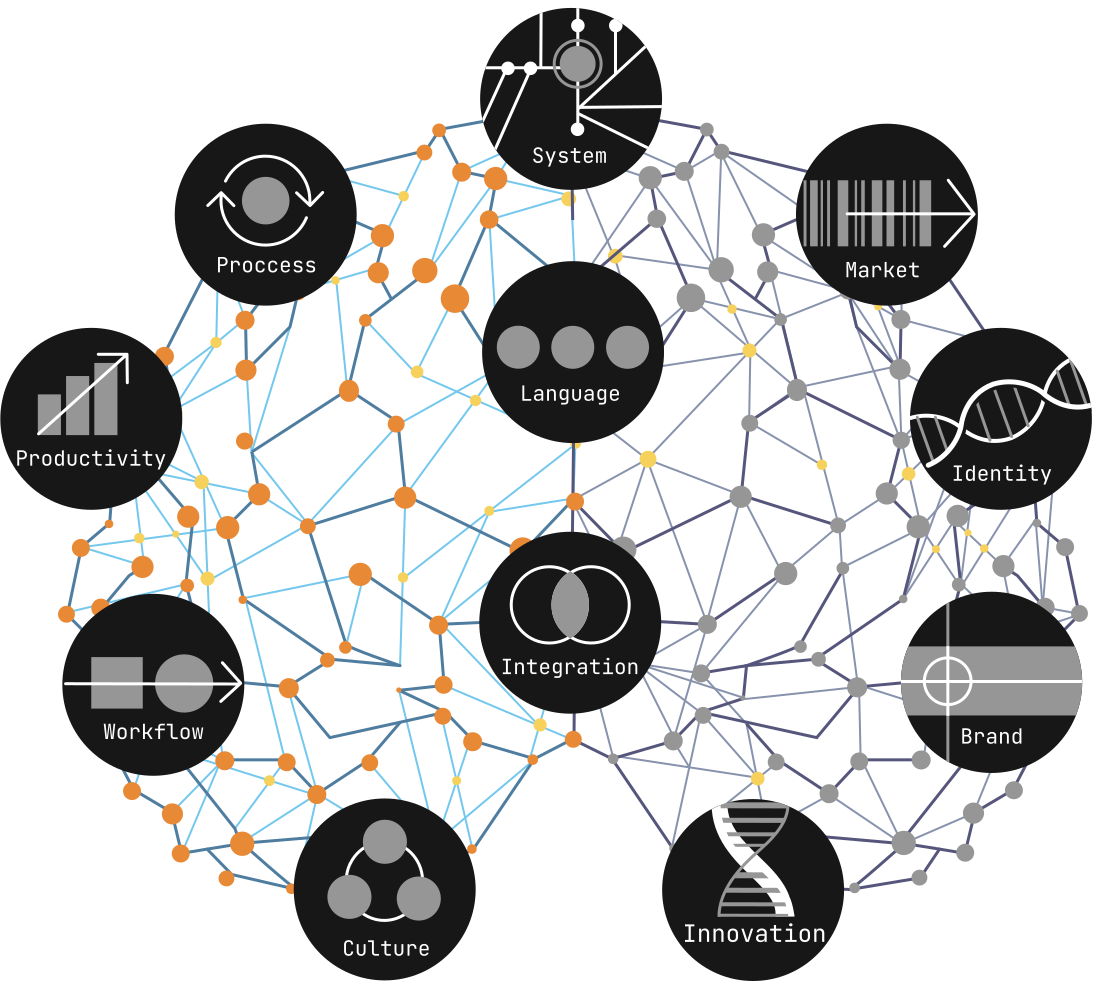
Your organization speaks hundreds of incompatible languages: marketing in Notion, sales in Salesforce, engineering in GitHub. AI can’t synthesize “competitive analysis” and “market intelligence” even when they name the same thing.
Universal Cognitive Architecture (UCA) solves it the way libraries did, with universal classification. The 11 Organizational Cognates structure your knowledge so memory is retrieved by address, not search.
Constitutional Memory
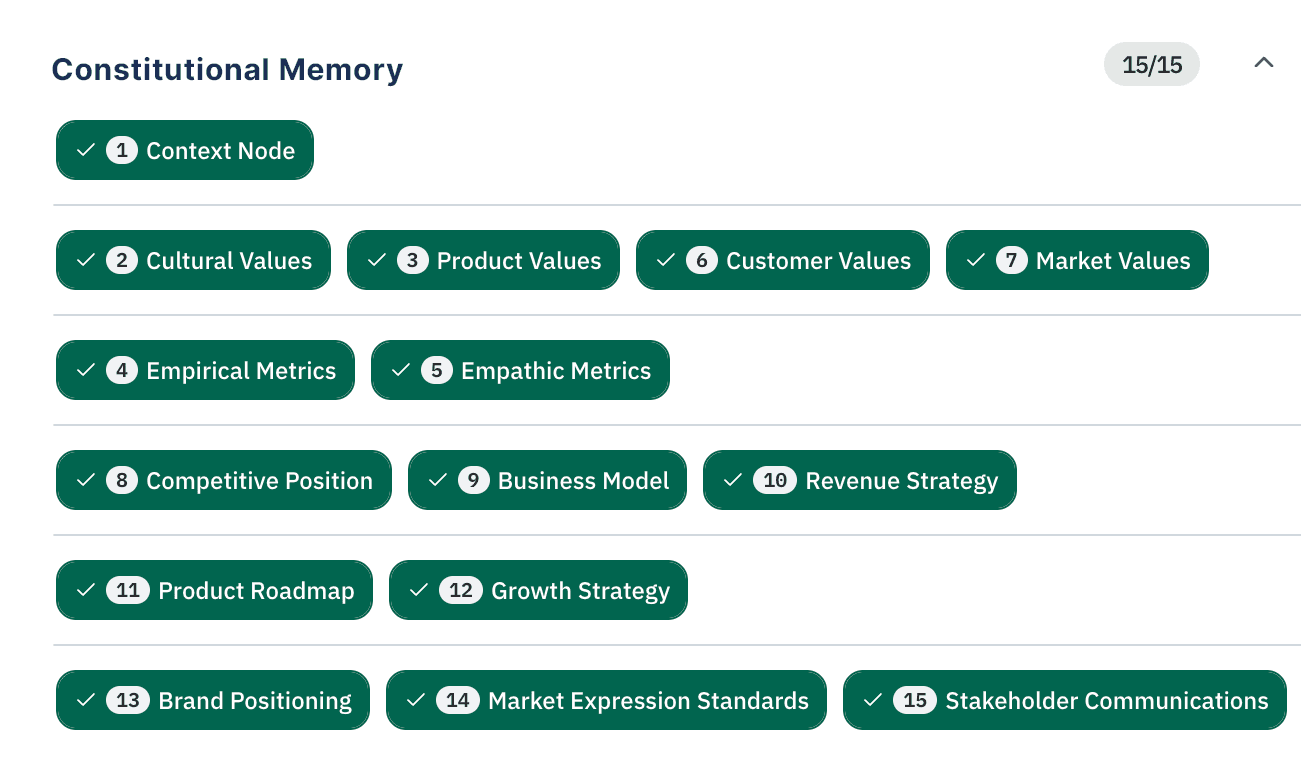
Write the First Fifteen.
Starling provisions your sovereign repository (Nests or Notion) and drafts your Constitutional Memories, the fifteen fundamentals every business needs to codify: values, competitive position, business model, revenue strategy, product roadmap, brand, core metrics, and more. Starling does the drafting; you approve each memory. A mature company can do this in about an hour through web and document extraction; a startup, in an afternoon of conversation.
Cancel and the repository remains yours. The First Fifteen give any advanced model the ability to extrapolate additional memory.
Context per query
Context is assembled before the model call.
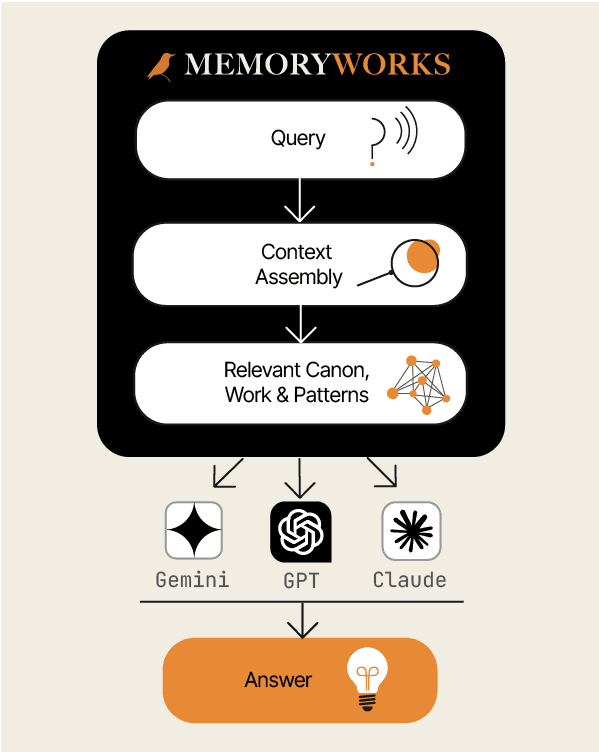
Starling’s machine-side manifest assembles context from your human-side repository for every query. The AI reads your canon, reasons over it, does the work, and forgets.
No vector-database drift, no widening retrieval-augmented generation (RAG) search. Steward mode keeps the canon current, so a Monday pivot lands Monday.
Model-agnostic chief of staff
Ask anything. Select the right model for the job.
Smart Office, our self-serve platform, works across Claude, GPT, and Gemini. Smart Enterprise, for larger organizations, plugs into any AI system. We recommend and you pick the model that fits the task, all reading from the same governed memory.
Your team asks; Starling answers from what your business actually knows, then drafts and plans with you — you decide.
Ask me anything, Matt
The asset compounds
The memory compounds; the AI is a governed utility.
Starling comes with an operating manual for System Librarians, the administrators who oversee your organization’s Canon (Persistent Memory) and Patterns (Learning Memory), and assign Projects (Active Memory) to departmental leaders. Folder Owners manage Projects.
Work a person approves is filed back into the library, so each task leaves the next one better informed. The AI advises, drafts, and recommends. It does not decide.
Put together
Five moves make a Domain Language Model.
Four parts. The fourth has two elements, an operating system and a library, so each move gives you one piece.
- 01 Classify
- UCA. The open standard that gives knowledge a permanent address. Free.
- 02 Codify
- The library. For a business, the Org Library, the memory your whole team works from.
- 03 Assemble
- MCP. The open protocol a model uses to reach a repository. Free.
- 04 Work
- Stateless LLM. Any leading model. You know it already.
- 05 Govern
- The operating system. A system library that creates and governs the user library. In an Org Brain, Starling OS provides it.
The library and operating system together are the Sovereign Repository. One can be built for any domain, as long as it includes both.
Start now
Ready to make your business speakable to AI?
Start free with the open standard, or hire the full chief of staff from $99/month.