Pricing
Public betaOne seat. Your whole team.
Starling MX is an AI chief of staff that works from a memory you own. Pay for what the AI does. Not for who logs in. The model is a metered utility; the memory it reads is yours to keep.
$99/month
for the Owner’s Seat, with $99 of AI usage included. Beyond that, your whole team draws from one prepaid pool at cost-plus, and you set the cap.
For example, a ten-person team, mostly light users with two working in it daily, runs about $270–$670 a month in beta, seat included.
Available to US businesses during the beta. Anywhere else, start with the free standard; it works with any AI, in any country.
Ownership
Seat 1 is Owner 1.
As the first Owner, you lead the initial build of your Org Library. Starling helps draft the First Fifteen, the fundamentals every business needs in writing, and you refine and approve each one. A mature company can do this in about an hour by extracting from its website and documents; a startup can work through its fundamentals as fifteen progressive conversations.
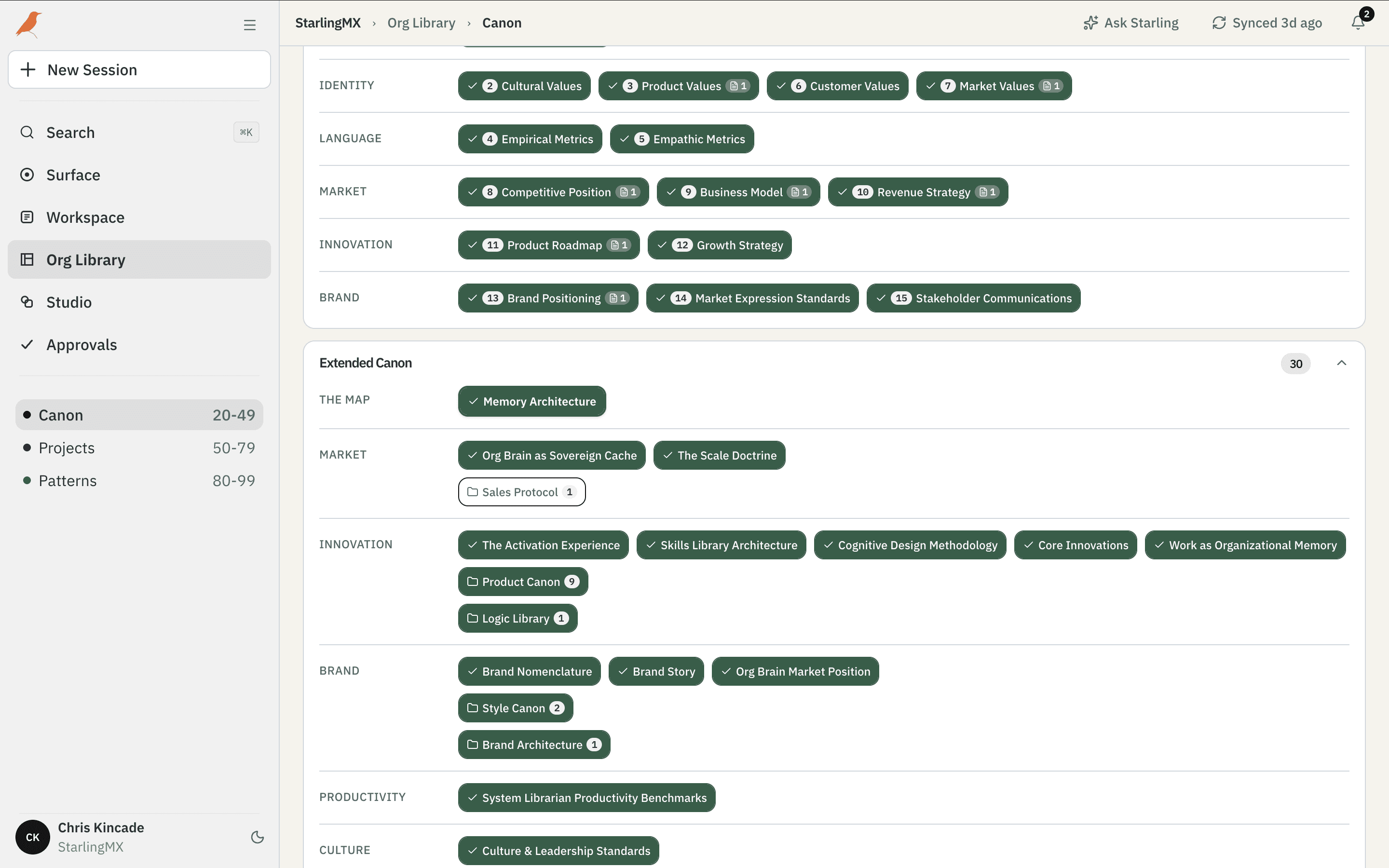
Then you set the Memory Architecture, the map of where everything else lives, and bring in your team: more Owners, System Librarians to govern the library, and Team Members to work from it. None of them needs a seat.
Elena Ricci · Publicist
Reads
- Public Canon
- Read
- Learning Memory
- Read
- BR60 · Brand Master
- Read
- BR61 · PR Master
- Owner
Her workspace
Shares — she governs
- BR61_01 Positioning
- Org
- BR61_02 Coverage
- Org
- BR61_03 Thought-Leadership
- Org
- BR61_04 Executive Comms
- CEO only
Governed access
Invite anyone. Access follows the folder.
Access on the Org Brain is a decision, not an open door. One seat covers your whole team — and you can bring outsiders in, scoped to exactly what they need. In one governed workspace, Elena reads the org’s canon and owns her folder. She shares some work company-wide and the sensitive drafts with a single reader.
What you pay for
You pay to govern. Everyone works.
One Owner’s Seat governs the memory. Your whole team reads and writes to it, by permission.
One seat is paid. $99 a month. The Owner can appoint System Librarians to govern the Org Library, approve Canon and Patterns, and assign Projects to Folder Owners, typically departmental leaders.
After Seat 1, everyone else, including more Owners, joins without a seat. Your co-founders, team, publicist, lawyer and contractors all read and write in the same governed memory. Access is set by master folder, inherited by everything inside it, and adjustable down to a single file.
Usage is metered at cost-plus. The work Starling does draws from one prepaid pool, on any model you select, capped by you.
YOU PAY TO GOVERN
ORG BRAIN
EVERYONE WORKS
$99 / month
No seat
No seats
METERED · COST-PLUS
YOU PAY TO GOVERN
$99 / month
No seat
ORG BRAIN
EVERYONE WORKS
No seats
METERED · COST-PLUS
What it costs
Pay for work, not headcount.
Your team’s usage scales with the work. Nests are included; Notion requires its own subscription.
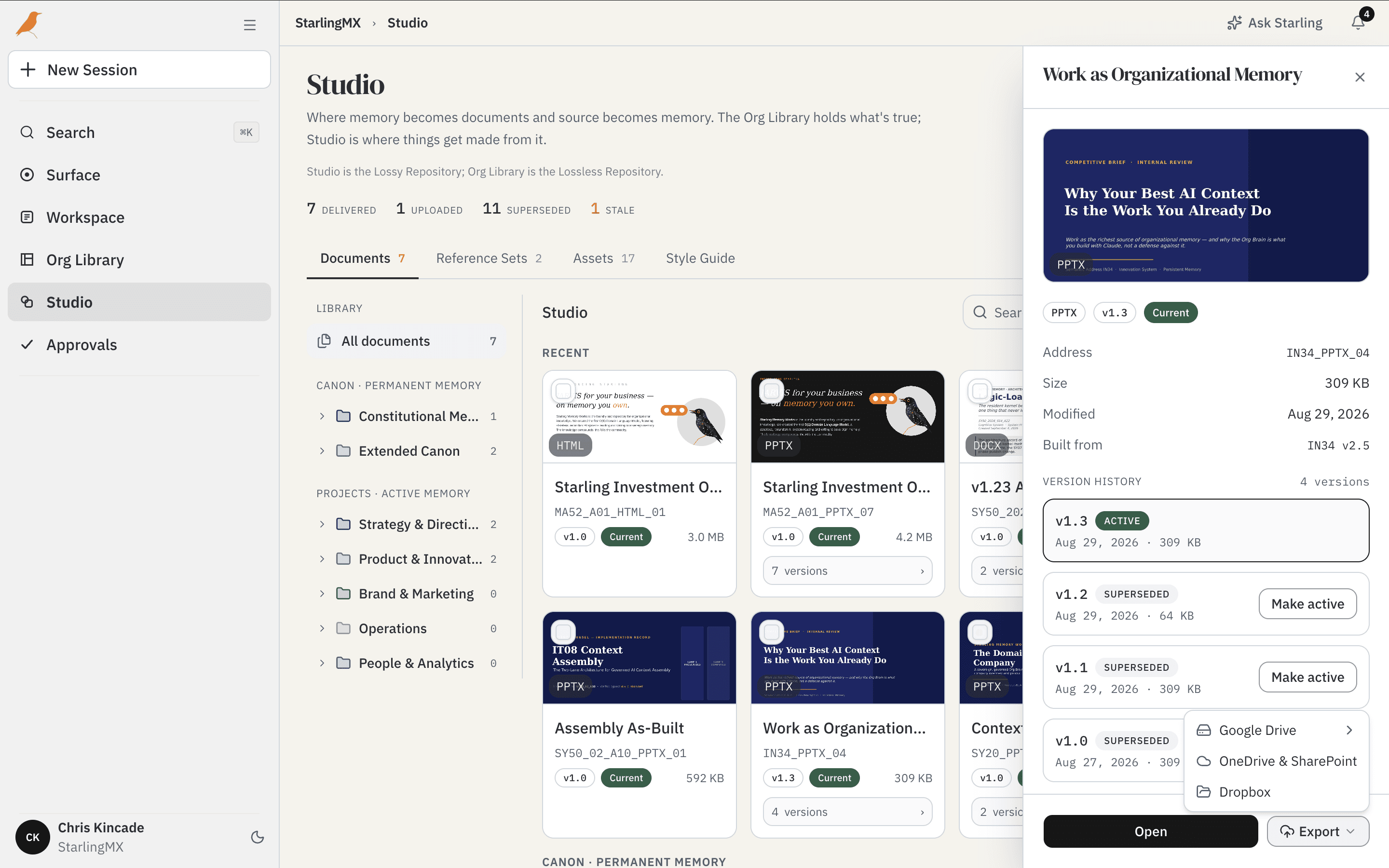
Starling fits the stack you already have. Studio imports from and exports to Google Drive, OneDrive, and Dropbox, and produces native Microsoft Office files, so work lands where your team already is, in formats they know. Connecting the AI your organization already runs is part of Smart Enterprise. On your own, the free standard works in a Claude or ChatGPT project. Scale Starling to your needs.
What it runs
Sized to your work, capped by you.
Every task your team runs draws on one prepaid pool, billed at cost-plus. You set the limit, and each cost shows up as it runs.
FAQs
What you need to know
Something else on your mind? Send us a note. We typically respond within one business day.

How it’s priced
Choose where to start.
No per-seat tax. You pay for what the AI does, on memory you own. Your first month builds the Org Library. Cancel anytime and it stays yours.

UCA
Classification Standard
The filing system for what your business knows. Write your business down, turn the model’s memory off. Free forever — a standard, not a trial.

Smart Office
$99/month + metered usage
One Owner’s Seat — invite the rest of your team with no seat fees. Usage draws from a shared pool, on any model you select. Combine models by task.
Plug in Existing AI
Smart Enterprise
Keep the AI you already run. We connect your Org Brain to your stack — managed on Starling MX or self-hosted in your own AWS. We’ll train your team, too.
Accelerator leaders
Starling is powered by Cognitive Design — the discipline that turns how a business works into knowledge an AI can build on. Give every founder in your cohort an Org Brain from day one.
Partner with us